
Artificial intelligence has quickly become the centrepiece of conversations about knowledge management. Organisations are investing heavily in AI-powered assistants capable of transcribing meetings, summarising reports, recommending documents and answering questions drawn from thousands of pages of organisational content. Whilst these developments are undoubtedly exciting, they also risk encouraging institutions to ask the wrong question first.
The question should never be, “How can we use AI?” It should be, “Why does this knowledge exist in the first place, who does it serve, and what difference should it make?”
Technology cannot define a knowledge management strategy. It can only strengthen one that already has a clear purpose. Before discussing AI, metadata, taxonomies or digital platforms, an organisation must first understand the role that knowledge plays in achieving its mission.
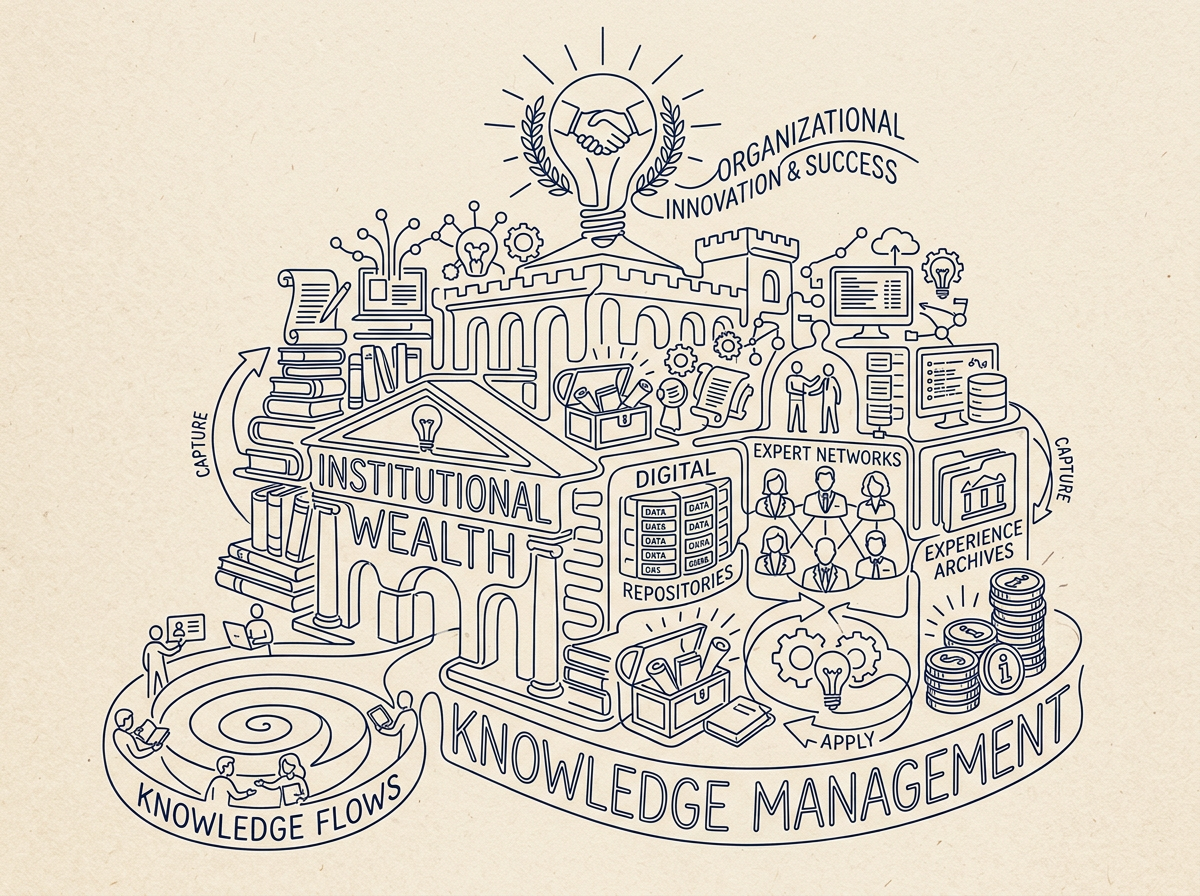
For a global development institution, knowledge is not simply information. It is an institutional asset accumulated through decades of research, project implementation, policy dialogue, evaluation, innovation and collaboration with governments and development partners. It represents lessons learned, successful practices, failures that should not be repeated and expertise that can improve future decisions. Knowledge management exists to ensure that this collective experience remains accessible, trustworthy and actionable long after individual projects have ended.
Using gender as an example illustrates this particularly well. Gender equality is not the responsibility of a single department operating in isolation. It is a cross-cutting development priority that influences education, health, agriculture, climate resilience, infrastructure, digital transformation, social protection and economic growth. Consequently, knowledge about gender is dispersed across numerous programmes, countries and sectors. Without a deliberate strategy to organise and connect that knowledge, valuable experience risks becoming fragmented, duplicated or forgotten.
Before designing a taxonomy or selecting a technology platform, however, I would begin by asking a series of strategic questions.
The first question is deceptively simple: Why are we managing this knowledge at all?
The answer cannot be “to store documents”. Organisations do not invest in knowledge management because they enjoy building repositories. They invest because better knowledge leads to better decisions.
A robust gender knowledge management strategy should enable project teams to design stronger interventions, policymakers to draw upon credible evidence, specialists to learn from previous experience and development partners to apply proven approaches within their own contexts. Ultimately, knowledge should contribute to better development outcomes rather than simply better document management.
The second question naturally follows: Who does this knowledge serve?
Within a large institution, different users require different forms of knowledge. Country teams may need operational guidance when integrating gender considerations into new projects. Economists may require evidence demonstrating the impact of women’s economic participation. Gender specialists may seek examples of successful interventions in similar contexts. Senior leadership may need concise analyses to inform strategic decisions. Learning professionals may wish to convert operational knowledge into professional development programmes.
The audience extends well beyond the institution itself. Governments, ministries, universities, civil society organisations, donors and private sector partners all rely upon the knowledge generated through development operations. For many stakeholders, the value of an institution lies not only in its financing but also in its ability to share decades of accumulated experience. A knowledge management strategy therefore serves an ecosystem rather than a single department.
The third question is perhaps the most important of all: What decisions should this knowledge improve?
This question fundamentally changes how success is measured. Rather than counting the number of reports published or documents downloaded, organisations should ask whether knowledge has helped someone make a better decision. Has it enabled a project team to avoid repeating a previous mistake? Has it helped a government adopt an evidence-informed policy? Has it strengthened programme design by drawing upon lessons from another region? Knowledge creates value only when it informs action.
Only after answering these questions should an organisation begin identifying its mission-critical knowledge assets. Not every document deserves equal attention. The most valuable assets are often those that continue to generate value long after a project concludes: flagship research, implementation guidance, operational procedures, evaluations, country diagnostics, case studies, communities of practice, expert interviews, learning resources and lessons learned. These are the resources that preserve institutional memory and transform individual experience into organisational capability.
With a clear understanding of purpose and users, the next step is to design a taxonomy. A taxonomy is frequently mistaken for a filing system, but it is far more significant than that. It provides the shared language through which knowledge can be discovered, connected and reused. In a gender knowledge ecosystem, information might be organised according to thematic areas such as women’s economic empowerment, gender-based violence, leadership, education or financial inclusion. Additional metadata may include region, country, sector, project lifecycle, intended audience, knowledge product type and publication status. A well-designed taxonomy reflects how people search for knowledge rather than how departments happen to be organised.
However, even the most elegant taxonomy will fail without effective governance. Governance determines who owns particular knowledge domains, who validates new content, who maintains metadata, who reviews outdated materials and who ensures that organisational standards are consistently applied. Without governance, repositories quickly become overcrowded with duplicate, contradictory or obsolete information, reducing confidence in the very systems intended to support organisational learning.
Only once these foundations are firmly established does artificial intelligence become truly valuable. AI can accelerate many aspects of knowledge management by summarising lengthy reports, identifying relevant expertise, recommending related resources, suggesting metadata, translating documents and allowing staff to search organisational knowledge using natural language rather than complex keywords. A project manager might ask, “Show me successful approaches to increasing women’s participation in agricultural value chains in small island developing states,” and receive synthesised evidence drawn from projects, evaluations, guidance notes and communities of practice.
Yet AI should never replace professional judgement. Its effectiveness depends entirely upon the quality of the knowledge ecosystem that supports it. Poorly organised information, inconsistent metadata and weak governance inevitably produce unreliable outputs. AI does not solve these problems; it simply reveals them more quickly.
This is why ethical and responsible AI must form part of any modern knowledge management strategy. Organisations should establish clear principles governing transparency, human oversight, privacy, security and bias. AI-generated outputs should be reviewed by subject matter experts before influencing policy or operational decisions. Sensitive information must remain appropriately protected, and users should understand when they are interacting with AI-assisted rather than human-generated content. Trust is one of an institution’s most valuable assets, and responsible governance ensures that AI strengthens rather than weakens that trust.
Finally, a knowledge management strategy should never be regarded as complete. Development priorities evolve, organisational structures change, new evidence emerges and technologies continue to advance. The knowledge ecosystem must therefore remain adaptable. Taxonomies should be reviewed regularly. New themes should be incorporated as global priorities shift. Communities of practice should evolve alongside emerging challenges, and AI capabilities should be introduced thoughtfully as governance and organisational maturity increase.
Knowledge management is not a repository. It is not a software platform. Nor is it an artificial intelligence initiative. It is a strategic organisational capability that ensures valuable knowledge remains relevant, discoverable, trustworthy and actionable for everyone who depends upon it. Artificial intelligence will undoubtedly play an increasingly important role in that future, but it should never be the starting point. The true foundation of knowledge management has always been understanding why knowledge matters, who it serves and how it enables better decisions in pursuit of lasting development outcomes.